What Are Creator Platforms?
- Selling subscriptions or memberships
- Launching digital products or courses
- Hosting paid communities
- Connecting with brands for UGC campaigns
- Managing audience data and analytics
Types of Creator Platforms
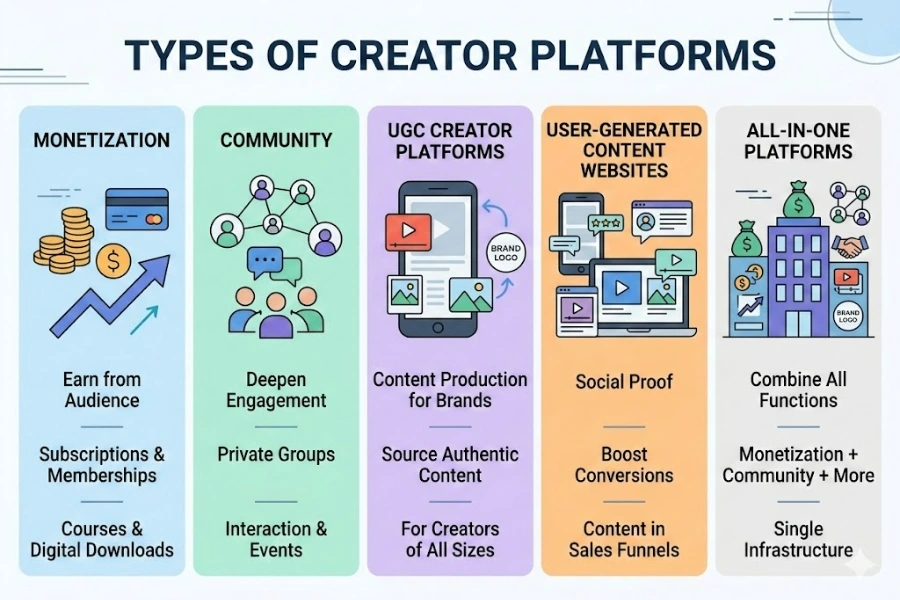
Not all creator platforms serve the same purpose. Some are built for monetization. Others focus on brand collaborations. Some specialize in community building, while others operate as marketplaces for user-generated content.
Understanding the categories helps you choose the right infrastructure instead of stacking random tools together.
Here are the main types you’ll see in today’s ecosystem:
Monetization Platforms
These platforms help creators earn directly from their audience. Instead of relying on brand deals, creators generate income through subscriptions, memberships, courses, digital downloads, or exclusive content.
They typically offer:
- Payment processing
- Subscription management
- Gated content systems
- Analytics nd revenue tracking
These are ideal for creators who want recurring income and greater financial independence.
Community Platforms
Community-focused platforms are designed to deepen engagement. Instead of broadcasting to followers, creators build structured spaces where members interact with each other.
Common features include:
- Private groups
- Tiered access levels
- Direct messaging
- Event hosting
- Moderation tools
These platforms are often used alongside monetization tools to increase retention and lifetime value.
Ready to build? Discover the best community platforms to get started now.
UGC Creator Platforms
This category has grown rapidly in recent years.
UGC creator platforms connect brands with creators who produce user-generated content for marketing campaigns. Unlike traditional influencer marketing, the focus here isn’t audience size — it’s content production.
Brands use these platforms to:
- Source authentic video and photo content
- Run performance-based campaigns
- Test ad creatives at scale
For creators, this opens up income opportunities even without a massive following.
User-Generated Content Websites
User-generated content websites are broader ecosystems where content comes directly from users — reviews, testimonials, tutorials, product showcases, and more.
Brands leverage these platforms to:
- Build social proof
- Improve conversion rates
- Repurpose content into ads
- Strengthen credibility
In many cases, these websites integrate directly with e-commerce systems, making UGC part of the sales funnel.
All-in-One Creator Platforms
Some newer platforms aim to combine monetization, community, analytics, and brand collaboration into a single system.
Instead of stitching together five different tools, creators can:
- Build their audience
- Sell products
- Manage memberships
- Track performance
- Connect with brands
As the ecosystem matures, this “infrastructure-first” model is becoming increasingly attractive.
Why Creator Platforms Matter More Than Ever
The Shift from Followers to Ownership
The Explosion of UGC for Brands
Infrastructure Is the New Competitive Advantage
How to Choose the Right Creator Platform
With so many creator platforms available, the real challenge isn’t access — it’s alignment. Choosing the wrong platform can slow growth, limit monetization, or create unnecessary technical complexity.
The right choice depends on what you’re optimizing for.
If You’re a Creator: Start With Your Revenue Model
Before comparing features, clarify how you plan to make money.
Are you building:
- A subscription-based community?
- A course or digital product business?
- A UGC production service for brands?
- A personal brand monetized through sponsorships?
Different platforms for creators are optimized for different monetization paths. A course-first creator needs robust content hosting and payment systems. A UGC-focused creator needs access to brand marketplaces and campaign dashboards.
Trying to force one model into the wrong platform creates friction.
Audience Ownership vs. Audience Reach
Some platforms prioritize distribution. Others prioritize ownership.
If your main goal is discovery, you may still rely heavily on social platforms. But if your goal is long-term stability, you need infrastructure that lets you:
- Collect emails
- Export audience data
- Manage customer relationships
- Control pricing and access
Ownership reduces dependency on algorithms and increases lifetime value.
Cost Structure and Scalability
Fees matter more than most creators realize.
Some creator platforms take a percentage of revenue. Others charge fixed monthly subscriptions. Some platforms add transaction fees on top of payment processing.
As revenue grows, these differences compound.
When evaluating platforms, consider:
- Platform fees
- Payment processing fees
- Upgrade tiers
- Feature limitations
- Integration costs
The cheapest option upfront isn’t always the most scalable long term.
Tech Stack Compatibility
Creators often underestimate how fragmented their systems become over time.
Email marketing tools. Landing page builders. Payment processors. Analytics dashboards. Community software. UGC sourcing tools.
If a platform integrates cleanly with your existing stack, growth becomes smoother. If not, you’ll spend more time managing tools than building value.
The best creator platforms reduce operational complexity instead of adding to it.
Looking for tips to grow your channel? Check out this article: 40 Social Media Content Ideas to Grow Your Audience in 2026
How Brands Use Creator Platforms to Scale Growth
Creator platforms aren’t just tools for individuals. Brands are using them just as aggressively — and often more strategically.
As paid ads become more expensive and consumers grow skeptical of polished marketing, brands are shifting toward creator-driven ecosystems. Instead of controlling every message, they collaborate, source, and scale content through creators.
Here’s how that plays out in practice.
Sourcing UGC at Scale
One-off influencer campaigns are expensive and hard to optimize. UGC creator platforms change that by turning content sourcing into a repeatable system.
Brands can:
- Brief multiple creators at once
- Test different hooks and formats
- Gather raw content for ads
- Iterate based on performance data
Instead of betting on one “big” collaboration, brands test fast and double down on what converts.
That’s the operational power of UGC for brands — it becomes part of the marketing engine, not a side experiment.
Turning UGC Into Performance Ads
The real magic happens after content is created.
Brands repurpose user-generated content across:
- Paid social ads
- Product landing pages
- Email campaigns
- Retargeting funnels
UGC often outperforms studio-produced ads because it feels native and relatable. It blends into feeds instead of interrupting them.
On user-generated content websites, reviews and testimonials also function as conversion multipliers. Social proof reduces friction at the point of purchase.
Authenticity scales when it’s structured.
Building Long-Term Creator Partnerships
The smartest brands aren’t constantly searching for new creators. They build ongoing relationships.
Long-term partnerships:
- Improve content quality over time
- Reduce onboarding friction
- Increase brand alignment
- Create consistency across campaigns
Creator platforms make it easier to manage these relationships through dashboards, contracts, and performance tracking.
Instead of transactional influencer deals, brands build creator networks.
Measuring ROI Beyond Vanity Metrics
Likes and comments are no longer enough.
Brands using creator platforms focus on:
- Cost per acquisition
- Conversion rates
- Return on ad spend
- Customer lifetime value
When UGC is integrated into paid acquisition systems, performance becomes measurable. That’s when creator marketing stops being “brand awareness” and starts driving predictable revenue.
Monetization Models Powering Creator Platforms
At the end of the day, creator platforms exist for one reason: to turn value into revenue.
But not all monetization models work the same way. Some prioritize recurring income. Others focus on transactions. Some rely on brand budgets, while others depend entirely on audience trust.
Understanding these models helps both creators and brands build more intentional strategies.
Subscription-Based Revenue
Subscriptions are one of the most stable models available to creators.
Instead of earning sporadically from sponsorships, creators generate predictable monthly income through:
- Paid memberships
- Exclusive communities
- Premium content tiers
- Private newsletters
This model works best when creators offer ongoing value — education, insights, curated content, or tight-knit community access.
The advantage is stability. The challenge is retention. Subscription platforms force creators to think long-term about value delivery.
Brand Sponsorships and UGC Deals
For creators who prefer not to manage products or communities, brand collaborations remain a major income stream.
Through UGC creator platforms and user-generated content websites, creators can earn by producing performance-driven content for brands.
This includes:
- Short-form video ads
- Product demonstrations
- Testimonials
- Creative variations for paid campaigns
Unlike traditional influencer deals, UGC compensation is often tied to content production rather than audience size.
It lowers entry barriers and expands opportunity.
Affiliate and Performance-Based Models
Affiliate programs allow creators to earn commissions for driving sales.
This model blends content and performance marketing. Instead of charging upfront fees, creators earn based on results.
It works particularly well when:
- The audience trusts recommendations
- The product aligns naturally with the creator’s niche
- Tracking infrastructure is reliable
For brands, this reduces risk. For creators, it rewards influence that converts — not just engagement.
Digital Products and Courses
Many platforms for creators are optimized for selling knowledge.
Online courses, templates, toolkits, coaching programs, and digital downloads allow creators to package expertise into scalable assets. Unlike subscriptions, these are often one-time purchases — but with higher price points.
This model shifts creators from content producers to product builders.
Margins can be strong. But success depends on clear positioning and audience trust.
Read more: Best Digital Products to Sell for Creators
Hybrid Monetization Ecosystems
The most resilient creators rarely rely on just one model.
They combine:
- Subscriptions for stability
- Digital products for scale
- UGC campaigns for cash flow
- Affiliate income for performance upside
Modern creator platforms increasingly support these hybrid ecosystems, allowing revenue streams to coexist inside a single infrastructure layer.
Diversification isn’t just smart — it’s protective.
Top Creator Platforms in 2026
Patreon – Best for Membership Monetization
- Predictable monthly income
- Built-in subscription infrastructure
- Strong brand recognition
Kajabi – Best for Knowledge Entrepreneurs
- Complete product + marketing stack
- High scalability
- Strong automation features
Mighty Networks – Best for Community-Led Growth
- Creators building niche communities rather than just selling standalone products.
- Aspire – Leading UGC Creator Platform for Brands
- Aspire is widely used by brands looking to scale influencer and UGC campaigns. It connects brands with creators and helps manage campaigns, contracts, payments, and performance tracking.
- Unlike traditional influencer outreach, Aspire enables systematic creator sourcing.
- Centralized campaign management
- Performance tracking
- Scalable creator discovery
Billo – Performance-Focused UGC Platform
Yotpo – User-Generated Content Website for eCommerce
Stan Store – Lightweight Monetization for Social Creators
The Future of Creator Platforms
Creator platforms have already reshaped how people monetize content. But the next phase isn’t just about better tools — it’s about deeper shifts in ownership, automation, and business models.
The creator economy is moving from experimentation to maturity. And infrastructure will define who wins.
From Influencer to Entrepreneur
The word “creator” used to mean someone who posts content. Increasingly, it means someone who runs a business.
More creators are thinking like operators:
- Building product funnels
- Structuring recurring revenue
- Investing in community retention
- Tracking metrics beyond engagement
Platforms for creators are evolving to support this shift. Instead of just hosting content, they’re adding CRM features, analytics dashboards, automation workflows, and deeper monetization layers.
The creator is no longer just an influencer. They’re becoming a micro–media company.
AI as the Infrastructure Layer
AI is rapidly integrating into creator platforms.
We’re seeing tools that:
- Generate content drafts
- Repurpose long-form content into short clips
- Optimize ad creatives
- Analyze audience behavior
- Automate outreach and campaign management
For UGC creator platforms and brands running UGC for brands, AI enables faster testing and creative iteration. Instead of manually reviewing dozens of submissions, brands can filter, score, and optimize content with data-backed insights.
Efficiency becomes a competitive advantage.
Community-Owned Ecosystems
Another major shift is ownership.
Creators are increasingly prioritizing:
- Direct audience access
- Portable data
- Revenue independence
- Reduced algorithm reliance
Some emerging user-generated content websites and creator ecosystems are experimenting with decentralized models, tokenized incentives, or community-driven governance structures.
While not all of these models will become mainstream, the direction is clear: creators want more control over their digital assets and revenue streams.
Platforms as Business Infrastructure
The biggest transformation is conceptual.
Creator platforms are no longer just distribution tools. They’re business infrastructure.
They handle payments, relationships, analytics, collaboration, and scalability. For brands, they function as performance engines for sourcing and deploying UGC at scale. For creators, they replace fragmented tool stacks with integrated ecosystems.
The next generation of successful creators and brands won’t just be the most creative. They’ll be the most structured.
Ready to Go Beyond Content?
Most creator platforms help you post or monetize. Very few help you validate and launch a real product.
If you’re a creator ready to move from audience-building to product-building, SprouX helps you refine your idea, validate demand, and launch — fast.
Stop guessing. Start validating. Explore SprouX and build your first knowledge product the right way.